What Your Blood Work Reveals About Fatigue — And Why Your Mitochondria Aren’t Working
Why Your Mitochondria Aren’t Working — And What Your Blood Work Reveals
There’s a particular kind of fatigue that’s hard to describe.
You’re not bedridden.
You’re not acutely ill.
You can still function.
But everything feels heavier than it should.
By early afternoon, your energy drops sharply.
Conversations take more effort.
Stairs feel steeper.
Your thoughts feel slower — not confused, just dulled.
You start to wonder:
Is this stress?
Is this aging?
Is this just how life feels now?
Then your labs come back.
“Everything looks fine.”
And you’re left holding two realities at once:
You don’t have a diagnosable disease.
But you also don’t feel well.
The missing piece is often not a dramatic lab abnormality.
It’s something quieter.
Cellular energy efficiency.
Energy Happens at the Cellular Level
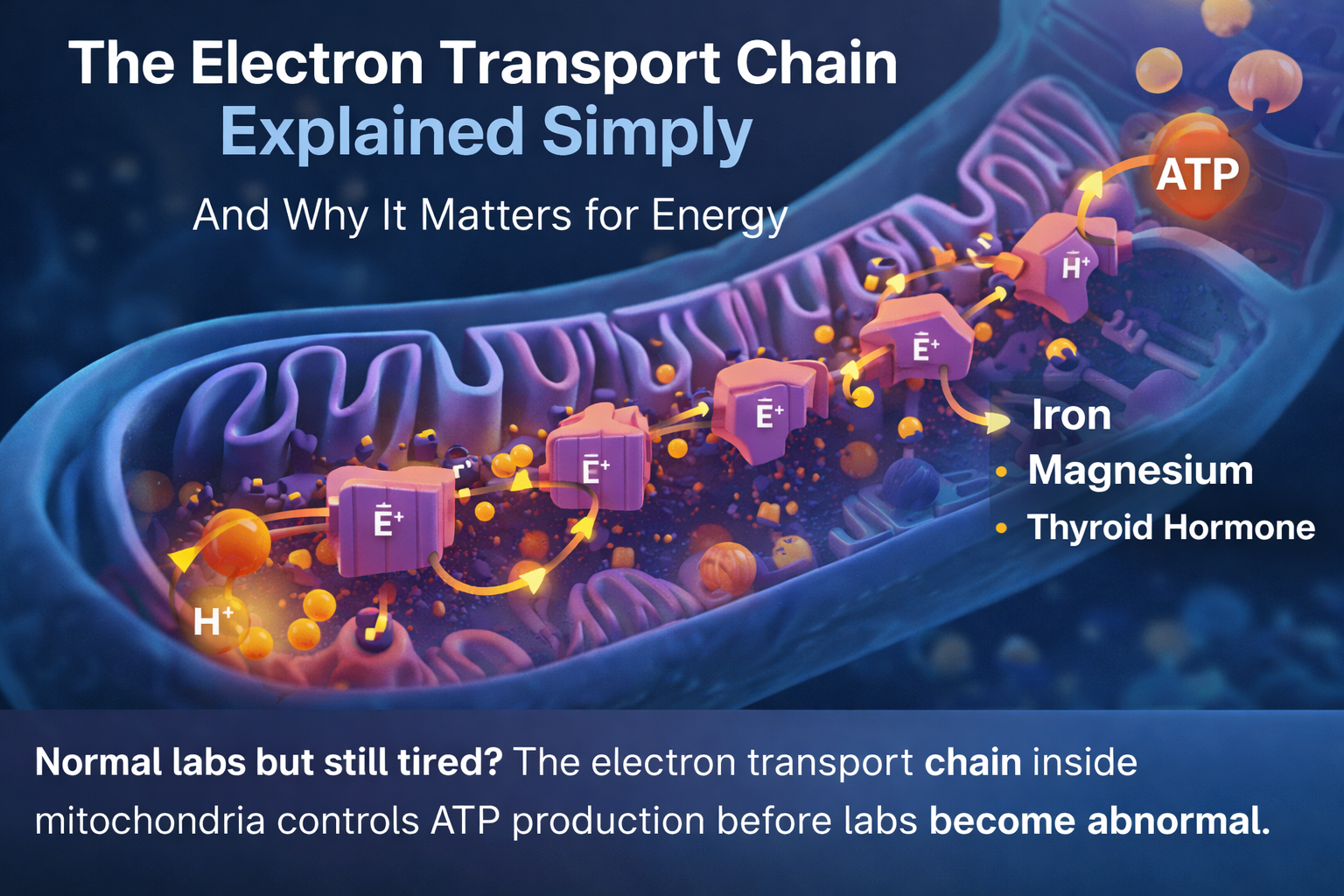
Inside every cell are mitochondria — structures responsible for producing ATP, the molecule that powers nearly every function in your body.
If this concept is new to you, start with What Is ATP and Why It Matters for Energy, Fatigue, and Mitochondrial Health.
When ATP production slows, fatigue often appears — even when standard labs remain within range.
This connects directly to the discussion in Why Am I Tired If My Labs Are Normal?
What Mitochondria Need to Produce Energy
ATP production depends on multiple inputs working together:
-
Iron – required for enzymes within the electron transport chain
-
Magnesium – activates ATP so it can be used
-
B Vitamins – drive the Krebs cycle
-
Oxygen – final electron acceptor
-
Thyroid Hormone – regulates mitochondrial output
-
CoQ10 – transfers electrons within the chain
-
Hydration & Electrolytes – maintain cellular voltage and enzyme efficiency
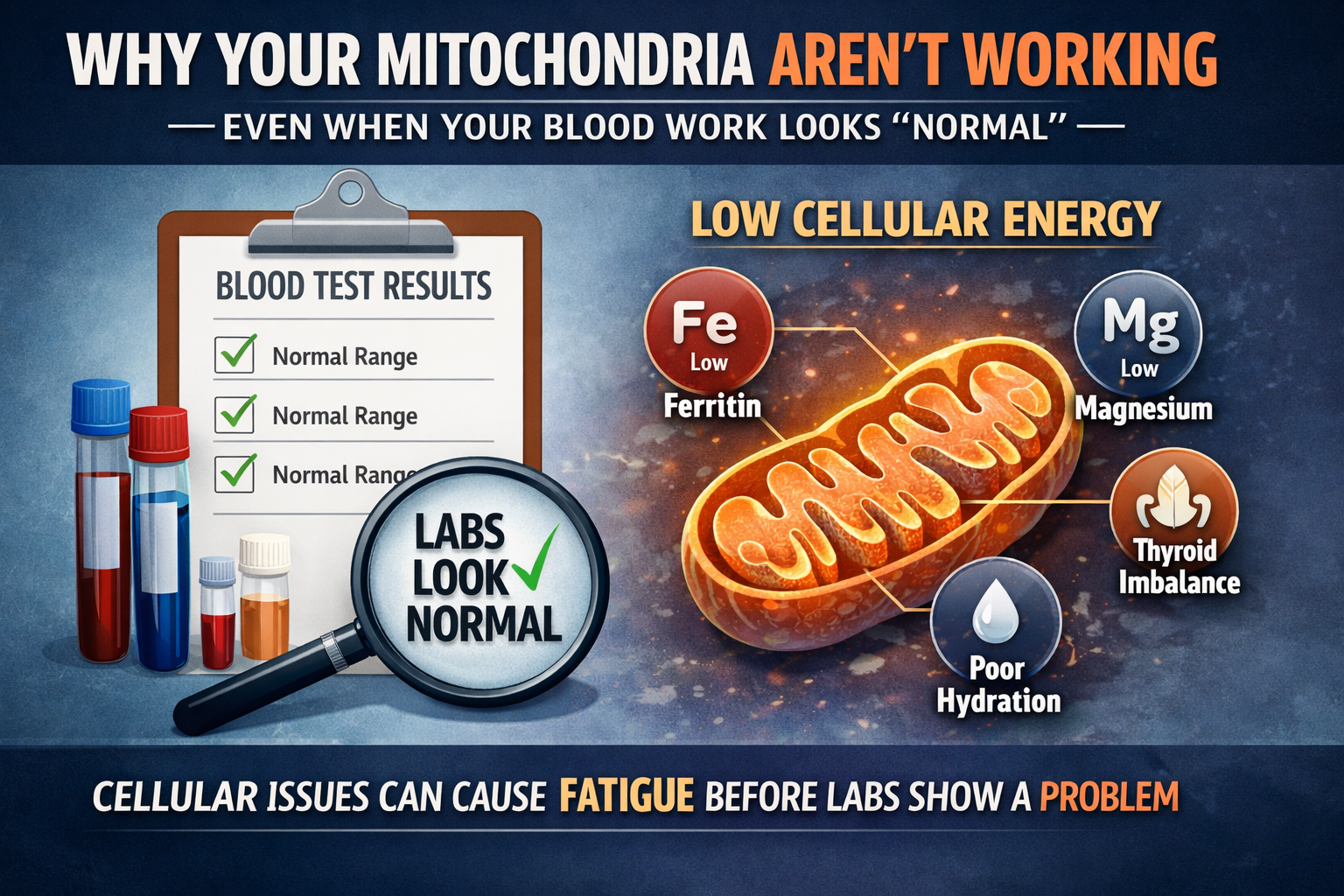
If one or more of these are mildly suboptimal — even within reference ranges — mitochondrial output may decline.
You may feel tired.
Your labs may still read “normal.”
Both can be true.
Iron Reserves vs Hemoglobin
Iron illustrates this difference clearly.
Hemoglobin reflects iron actively transporting oxygen in red blood cells.
Ferritin reflects stored iron reserves.
It is possible for hemoglobin to remain within range while ferritin levels are relatively low.
For a deeper explanation, see Low Ferritin but Normal Hemoglobin: What It Means.
Iron plays a direct role in mitochondrial enzymes responsible for oxidative phosphorylation.¹²
Research has shown that iron deficiency without anemia can affect fatigue and physical performance.
This does not necessarily indicate disease.
It reflects a spectrum of energy efficiency.
Magnesium and ATP Activation
ATP must bind to magnesium to function properly in the body.³
Even if ATP is produced, insufficient magnesium may reduce how effectively that energy is used.
Serum magnesium may fall within range while intracellular levels are less robust.
For more detail, read Magnesium and ATP: Why It Matters for Energy and Fatigue.
Thyroid and Mitochondrial Output
Thyroid hormones influence mitochondrial respiration and ATP production.⁴
TSH within range suggests the thyroid axis is functioning within expected limits.
However, mitochondrial responsiveness depends on cellular signaling efficiency.
You may find this helpful: Thyroid and Mitochondrial Energy: Why Normal TSH Doesn’t Always Mean Optimal Function.
Hydration and Cellular Voltage
Mitochondria operate within cells that depend on proper electrolyte balance and membrane gradients.
Hydration is not simply about drinking water.
It involves sodium, potassium, magnesium, and trace minerals that support cellular voltage.
For more on this concept, see Hydration & Electrolytes: Supporting Cellular Energy.
Viewing Labs Through a Broader Framework
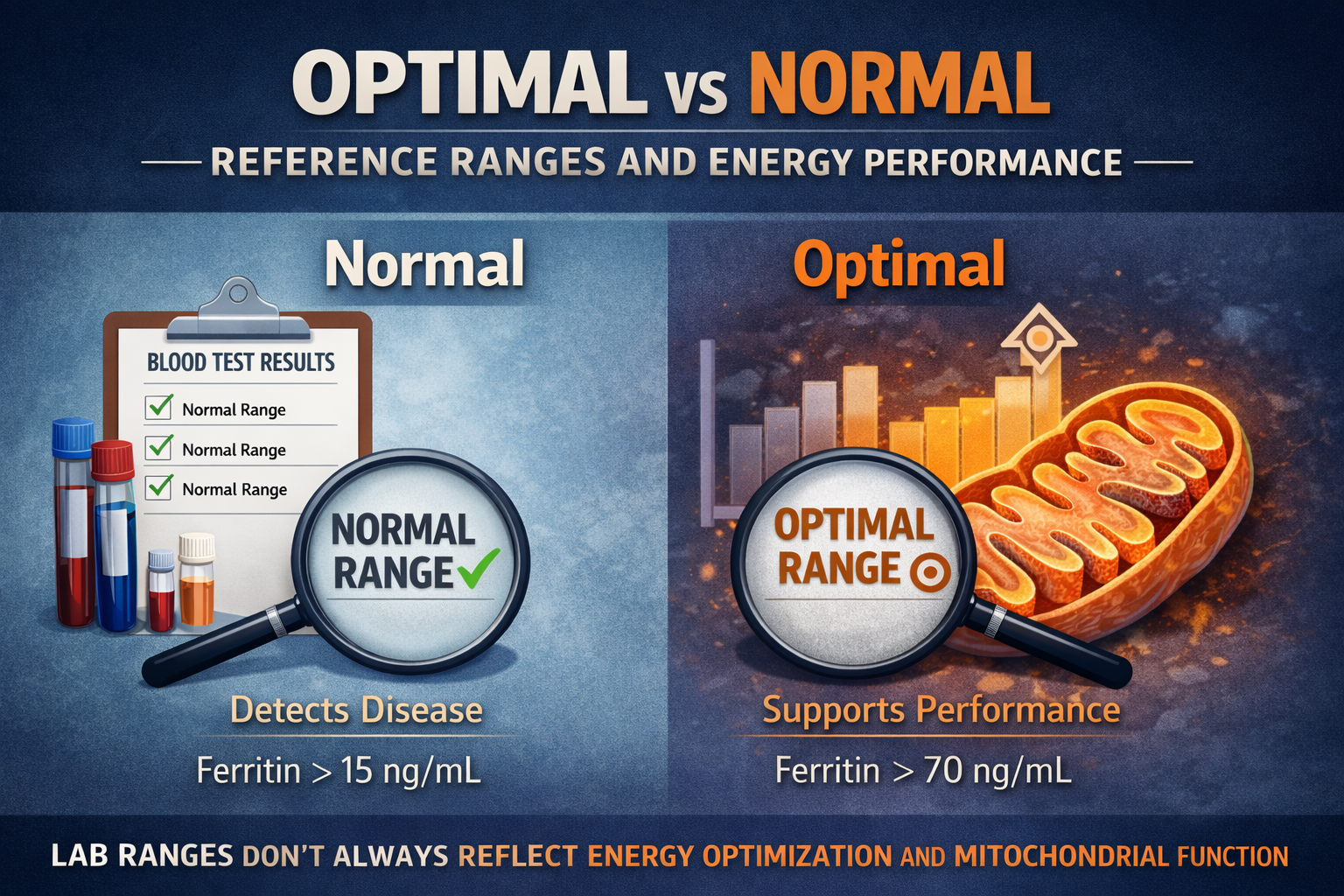
Standard lab ranges are designed to detect disease.
They are not calibrated to define optimal performance.
If fatigue persists despite “normal” labs, it may be helpful to look at patterns across markers rather than isolated values.
A structured approach is outlined in Educational Blood Lab Interpretation Guide.
This does not replace conventional evaluation.
It broadens the lens.
Disease detection and performance optimization operate at different thresholds.
Both are valuable.
They simply answer different questions.
Final Perspective
Your blood work may be normal.
That does not invalidate your lived experience.
It may simply mean no overt pathology is present.
Mitochondrial efficiency exists along a continuum.
When iron reserves, magnesium status, thyroid signaling, hydration, and nutrient cofactors align — energy tends to improve.
When several are mildly suboptimal, fatigue can appear long before labs cross into abnormal territory.
Understanding this distinction often brings clarity to the “normal labs but still tired” experience.
This article is educational in nature and not intended to diagnose or treat medical conditions. Always consult your healthcare provider regarding lab interpretation and treatment decisions.
Frequently Asked Questions
Can mitochondrial dysfunction cause fatigue even if labs are normal?
Yes. Standard laboratory ranges are designed to detect disease. Mitochondrial efficiency can decline before markers fall outside reference ranges.
What blood markers are connected to mitochondrial energy?
Ferritin (iron reserves), magnesium status, thyroid hormones (especially Free T3), B12, folate, and inflammatory markers such as hs-CRP all influence mitochondrial performance.
Can low ferritin cause fatigue without anemia?
Yes. Research shows iron deficiency without anemia can impair physical performance and increase fatigue before hemoglobin declines.
Does magnesium affect ATP production?
Yes. ATP must bind to magnesium to become biologically active inside the body.
Why would labs be normal but energy still low?
Because laboratory reference ranges focus on disease detection. Energy production depends on cellular efficiency, nutrient reserves, and hormone signaling — which may be suboptimal while still within range.