What Is ATP and Why It Matters for Energy, Fatigue, and Mitochondrial Health
What Is ATP and Why It Matters for Energy, Fatigue, and Mitochondrial Health
If you feel constantly tired, foggy, or drained — even though your labs are “normal” — the issue may not be calories, sleep, or motivation.
It may be cellular energy.
And cellular energy begins with ATP.
What Is ATP? (Simple Definition)
ATP (adenosine triphosphate) is the primary energy molecule used by every cell in your body.
Think of ATP as your body’s rechargeable battery.
Without ATP:
-
Muscles cannot contract
-
Brain cells cannot transmit signals
-
Hormones cannot activate properly
-
Detox pathways slow down
-
Repair processes stall
Every heartbeat, thought, and movement depends on ATP.
ATP is produced inside your mitochondria — tiny structures inside cells responsible for converting nutrients into usable energy.
When ATP production drops, energy drops.
How Does the Body Produce ATP?
Your body converts food into ATP through a highly coordinated three-stage process:
1. Glycolysis
Glucose is broken down into smaller molecules in the cytoplasm, producing a small amount of ATP.
2. The Krebs Cycle
Inside the mitochondria, energy intermediates are generated to prepare for large-scale ATP production.
3. The Electron Transport Chain
This is where the majority of ATP is produced.
Electrons move across mitochondrial membranes, creating a gradient that drives ATP synthesis through oxidative phosphorylation.
This final stage depends on:
-
Oxygen
-
Magnesium
-
Iron
-
B vitamins
-
Healthy thyroid signaling
-
Proper hydration and electrolyte balance
If any of these are suboptimal, ATP production becomes less efficient.
For a deeper breakdown of this process, see our guide on Mitochondrial Dysfunction.
Why ATP Is Essential for Energy
Energy is not simply about how much food you consume.
It is about how efficiently your cells convert nutrients into ATP.
ATP powers:
-
Brain function and mental clarity
-
Muscle strength and endurance
-
Hormone signaling
-
Immune defense
-
Detoxification
-
Cellular repair and regeneration
When ATP production declines, symptoms can appear even when lab results fall within standard reference ranges.
What Happens When ATP Is Low?
Low ATP pushes the body into conservation mode.
Common signs include:
-
Persistent fatigue
-
Brain fog
-
Exercise intolerance
-
Afternoon crashes
-
Cold sensitivity
-
Slow recovery after exertion
Many people experiencing these symptoms are told:
“Your labs are normal.”
But normal ranges are designed to rule out disease — not optimize mitochondrial performance.
If this sounds familiar, read:
Why Am I Tired If My Labs Are Normal?
What Causes Low ATP?
Low ATP production is rarely caused by a single factor. It is usually a pattern involving multiple stressors.
Mitochondrial Dysfunction
Inefficient or stressed mitochondria produce less ATP.
Nutrient Deficiencies
ATP production requires adequate levels of:
-
Magnesium
-
Iron (ferritin)
-
Vitamin B12
-
Folate
-
Vitamin B6
-
Riboflavin
-
Niacin
-
CoQ10
Suboptimal levels may impair energy production without triggering disease flags.
Thyroid Imbalance
Thyroid hormones regulate mitochondrial activity.
Low T3 can significantly reduce ATP output.
Chronic Stress and Inflammation
Elevated cortisol and inflammatory cytokines interfere with mitochondrial efficiency.
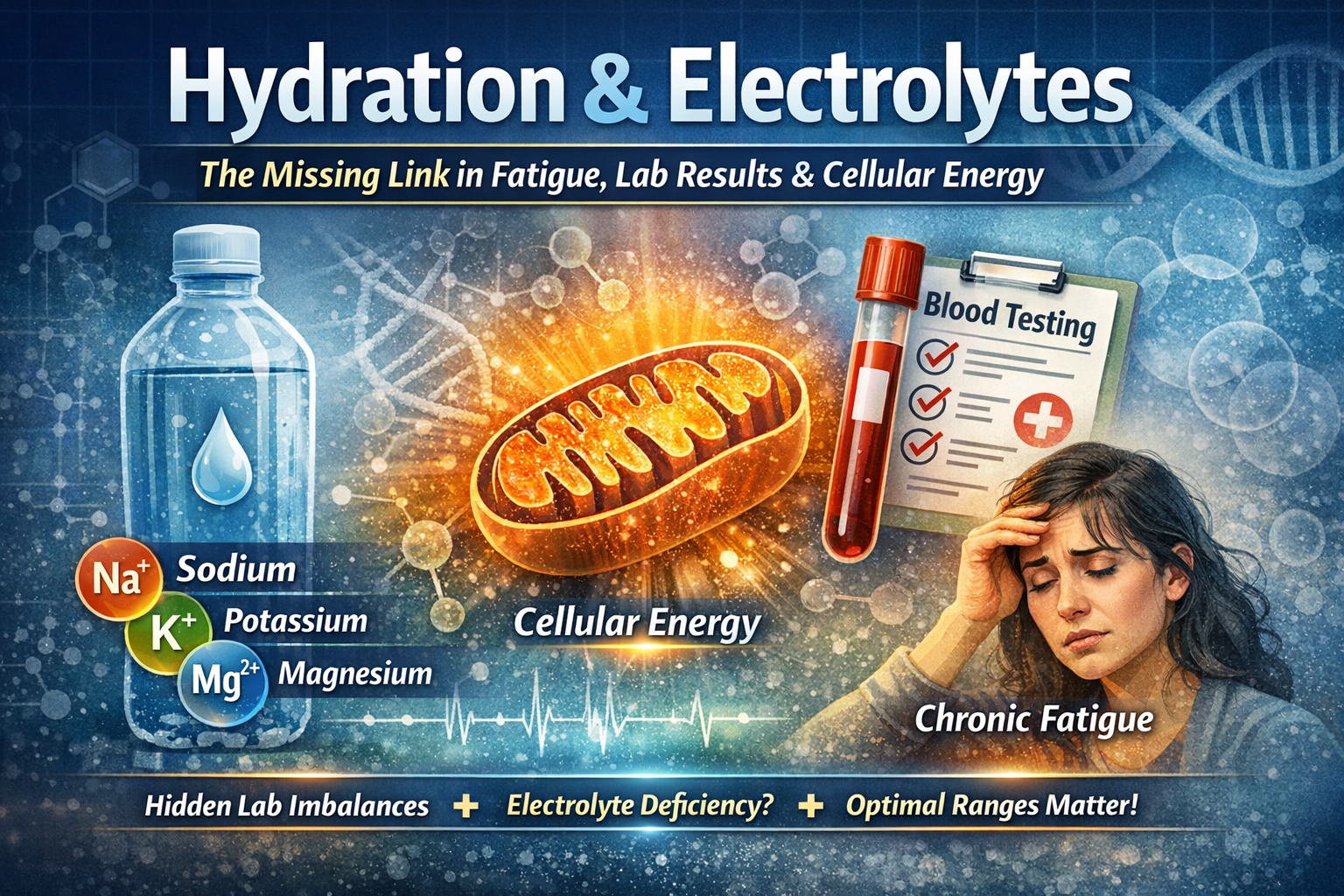
Dehydration and Electrolyte Imbalance
ATP synthesis depends on membrane voltage and mineral balance.
Electrolyte disruption can impair this process.
Learn more in our guide on Hydration & Electrolytes.
Can Blood Work Reveal Low ATP?
There is no single laboratory test that directly measures ATP levels in routine practice.
However, patterns in standard blood work can suggest reduced cellular energy potential. Examples include:
-
Low or suboptimal ferritin
-
Borderline vitamin B12
-
Elevated homocysteine
-
Suboptimal magnesium
-
Thyroid conversion issues
-
Elevated inflammatory markers
Educational blood lab interpretation focuses on identifying these patterns — even when results fall within conventional reference ranges.
Learn more in our Educational Blood Lab Interpretation Guide.
How to Support ATP Production Naturally
Supporting ATP production involves improving mitochondrial efficiency and nutrient availability.
1. Optimize Key Nutrients
Magnesium, iron (when appropriate), B vitamins, and CoQ10 support energy metabolism pathways.
2. Improve Hydration and Electrolytes
Balanced sodium, potassium, and magnesium support cellular voltage and mitochondrial function.
3. Support Healthy Thyroid Function
Adequate thyroid signaling improves mitochondrial output.
4. Prioritize Deep Sleep
Mitochondria repair and regenerate during restorative sleep.
5. Reduce Chronic Inflammation
Lowering inflammatory burden improves cellular energy efficiency.
The Bigger Picture: ATP and “Normal” Labs
Many individuals struggling with fatigue are not clinically diseased — they are metabolically suboptimal.
Their mitochondria are underperforming.
Their nutrient levels are borderline.
Their ATP production is inefficient.
Yet nothing is technically “out of range.”
This is the gap between normal and optimal.
Frequently Asked Questions About ATP and Energy
What is ATP in simple terms?
ATP (adenosine triphosphate) is the molecule your body uses as energy. Every cell relies on ATP to power essential processes including muscle contraction, brain signaling, hormone activation, detoxification, and cellular repair.
How do mitochondria produce ATP?
Mitochondria produce ATP through glycolysis, the Krebs cycle, and the electron transport chain. These processes convert nutrients and oxygen into usable cellular energy through oxidative phosphorylation.
What causes low ATP levels?
Low ATP production may result from mitochondrial dysfunction, nutrient deficiencies, thyroid imbalance, chronic stress, inflammation, dehydration, or poor sleep. Often, multiple factors interact rather than a single cause.
Can dehydration affect ATP production?
Yes. Proper hydration and electrolyte balance are essential for mitochondrial function. ATP synthesis depends on mineral gradients and membrane voltage within cells.
Can blood tests measure ATP directly?
Routine blood tests do not directly measure ATP. However, lab patterns — such as suboptimal ferritin, vitamin B12, magnesium, thyroid markers, or inflammatory markers — may suggest reduced cellular energy production.
Why am I tired if my labs are normal?
Standard lab reference ranges are designed to detect disease, not optimize cellular performance. It is possible to fall within normal limits while still experiencing suboptimal nutrient levels or impaired mitochondrial efficiency.