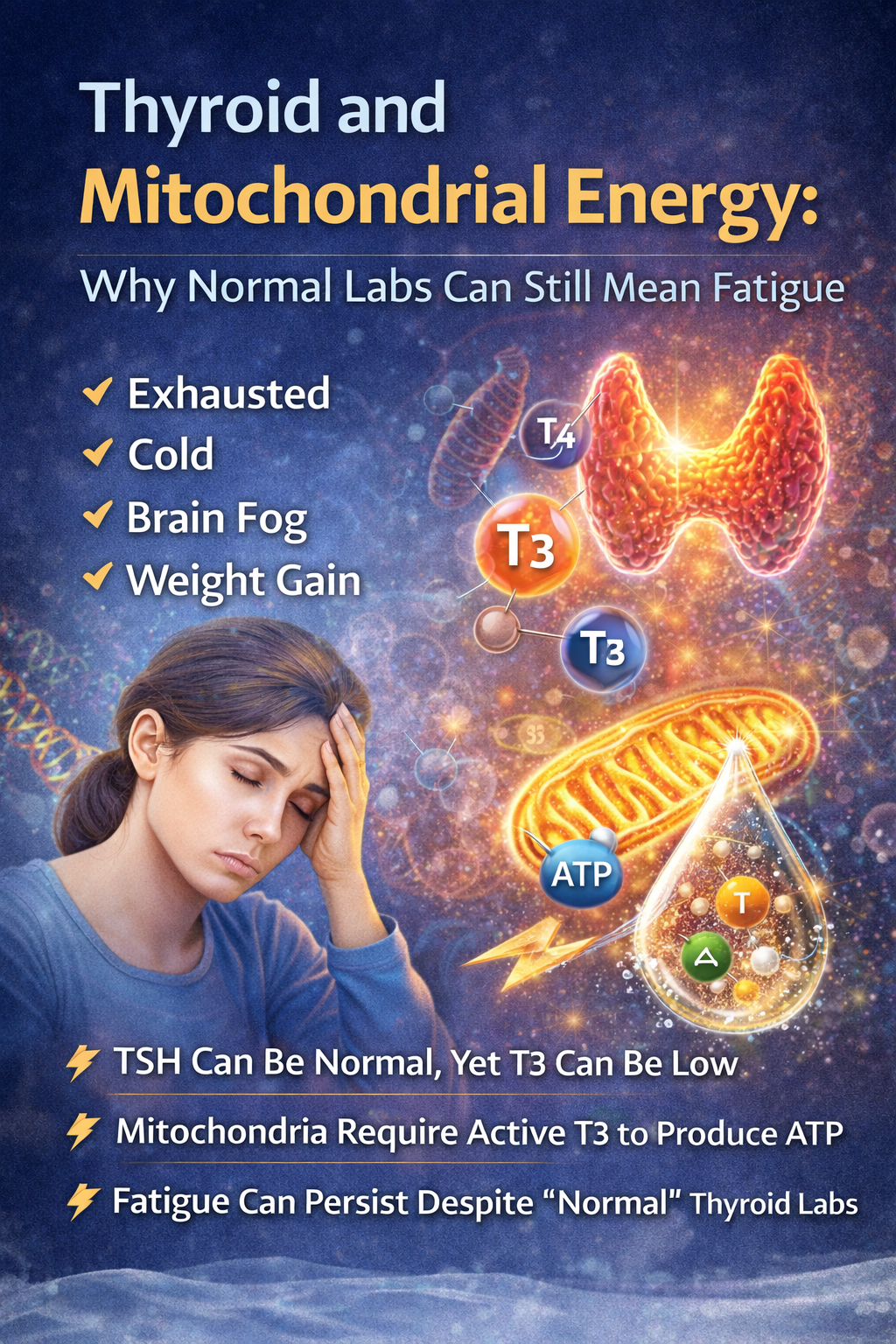
Thyroid and Mitochondrial Energy: Why “Normal” Labs Can Still Leave You Exhausted
You were just told your thyroid is “fine.”
TSH? Normal.
T4? Normal.
But you’re still:
→ Exhausted by 2 PM
→ Cold all the time
→ Forgetting words mid-sentence
→ Gaining weight despite eating less
Here’s what many people are not told:
TSH does not measure how much thyroid hormone your cells are actually using.
It measures how strongly the pituitary is signaling for thyroid hormone production.
If your cells are not receiving enough active T3, your mitochondria may be operating below optimal capacity.
And if mitochondrial output declines, energy declines.
Thyroid hormones regulate mitochondrial function and ATP production. When thyroid signaling is suboptimal — even within standard reference ranges — cellular energy output may decrease, contributing to fatigue, brain fog, and cold sensitivity.
What Does the Thyroid Do in Simple Terms?
The thyroid gland produces hormones that regulate how fast your body turns nutrients into energy.
The two primary hormones are:
• T4 (thyroxine)
• T3 (triiodothyronine)
T3 is the active hormone that signals cells to increase metabolic activity.
Thyroid hormones influence:
• Oxygen consumption
• Heat production
• Mitochondrial density
• ATP synthesis
• Cellular metabolic rate
Without adequate thyroid signaling, mitochondrial output slows.
How Thyroid Hormones Affect Mitochondria
Thyroid hormones increase:
• Mitochondrial biogenesis (creation of new mitochondria)
• Expression of mitochondrial enzymes
• Oxygen utilization
• Activity of the electron transport chain
T3 directly regulates genes involved in oxidative phosphorylation — the final stage of ATP production.
For a deeper explanation of ATP:
What Is ATP and Why It Matters for Energy, Fatigue, and Mitochondrial Health
https://cellushine.net/blogs/news/what-is-atp-and-why-it-matters-for-energy-fatigue-and-mitochondrial-health
When T3 levels are low — or when T4-to-T3 conversion is impaired — ATP production may decline.
Research Insight: Thyroid Hormones and Cellular Energy
Research demonstrates:
• T3 increases mitochondrial respiration and ATP synthesis
• Hypothyroidism is associated with reduced oxidative capacity
• Thyroid hormone regulates mitochondrial DNA transcription and replication
Selected references:
Weitzel JM, Iwen KA. Coordination of mitochondrial biogenesis by thyroid hormone. Molecular and Cellular Endocrinology. 2011.
Yen PM. Physiological and molecular basis of thyroid hormone action. Physiological Reviews. 2001.
Wrutniak-Cabello C et al. Thyroid hormone and mitochondria. Molecular and Cellular Endocrinology. 2001.
Mullur R et al. Thyroid hormone regulation of metabolism. Physiological Reviews. 2014.
These findings confirm that thyroid hormones are central regulators of mitochondrial energy metabolism.
Why “Normal” Thyroid Labs May Not Tell the Full Story
Standard thyroid panels typically include:
• TSH
• Free T4
• Sometimes Free T3
TSH reflects pituitary signaling — not tissue-level thyroid hormone activity.
Some individuals experience symptoms of thyroid fatigue with:
• TSH within reference range
• Low-normal Free T3
• Impaired T4-to-T3 conversion
• Elevated reverse T3
• Nutrient-related conversion inefficiency
If you’ve been told your labs are normal but still feel fatigued:
Why Am I Tired If My Labs Are Normal?
https://cellushine.net/pages/why-am-i-tired-if-my-labs-are-normal
For deeper lab context:
Educational Blood Lab Interpretation
https://cellushine.net/pages/educational-blood-lab-interpretation
Thyroid Conversion and Nutrient Status
T4 must convert into active T3.
This conversion depends on:
• Selenium (iodothyronine deiodinase enzymes)
• Iron (thyroid peroxidase function)
• Zinc
• Adequate caloric intake
• Reduced inflammation
Low iron may impair thyroid hormone synthesis and conversion.
See:
Iron, Ferritin, and Fatigue
https://cellushine.net/blogs/news/iron-ferritin-and-fatigue-how-low-iron-can-affect-cellular-energy
Magnesium also supports ATP activation and cellular signaling:
Magnesium and ATP: Why It Matters for Energy and Fatigue
https://cellushine.net/blogs/news/magnesium-and-atp-why-it-matters-for-energy-and-fatigue
Thyroid, Mitochondria, and Brain Fog
Reduced thyroid signaling may result in:
• Lower mitochondrial density
• Reduced oxidative phosphorylation
• Lower ATP production
• Cold intolerance
• Slower cognition
• Exercise intolerance
To understand how mitochondrial inefficiency presents:
Mitochondrial Dysfunction
https://cellushine.net/pages/mitochondrial-dysfunction
Hydration also influences mitochondrial efficiency:
Hydration & Electrolytes
https://cellushine.net/pages/hydration-electrolytes
Can You Have Thyroid-Related Fatigue With Normal Labs?
Yes.
Thyroid function operates along a spectrum.
Some individuals fall within reference ranges but may still experience:
• Low-normal T3 availability
• Impaired peripheral conversion
• Elevated cortisol interfering with signaling
• Inflammatory suppression of thyroid receptors
Patterns often provide more insight than isolated lab values.
The Bigger Picture: Thyroid as an Energy Regulator
The thyroid does not directly produce energy.
It regulates how efficiently mitochondria produce ATP.
When thyroid signaling is optimized:
• Mitochondrial density increases
• Oxygen consumption improves
• ATP production rises
• Energy output improves
When thyroid signaling declines, energy production slows.
Understanding this connection helps explain persistent fatigue despite “normal” thyroid results.
Part of the Cellular Energy Education Series
• What Is ATP and Why It Matters for Energy, Fatigue, and Mitochondrial Health
https://cellushine.net/blogs/news/what-is-atp-and-why-it-matters-for-energy-fatigue-and-mitochondrial-health
• Magnesium and ATP: Why It Matters for Energy and Fatigue
https://cellushine.net/blogs/news/magnesium-and-atp-why-it-matters-for-energy-and-fatigue
• Iron, Ferritin, and Fatigue
https://cellushine.net/blogs/news/iron-ferritin-and-fatigue-how-low-iron-can-affect-cellular-energy
• Hydration & Electrolytes
https://cellushine.net/pages/hydration-electrolytes
• Mitochondrial Dysfunction
https://cellushine.net/pages/mitochondrial-dysfunction
Frequently Asked Questions
Does thyroid hormone affect ATP production?
Yes. T3 increases mitochondrial respiration and oxidative phosphorylation, influencing ATP synthesis.
Can you have thyroid fatigue with normal TSH?
Yes. TSH does not always reflect tissue-level thyroid hormone activity or T3 availability.
What nutrients affect thyroid conversion?
Selenium, iron, zinc, and adequate caloric intake influence T4-to-T3 conversion.
How does hypothyroidism affect mitochondria?
Reduced thyroid signaling may decrease mitochondrial density and oxidative capacity.
Important Notice
This article is educational in nature and is not intended to diagnose, treat, or replace professional medical advice.