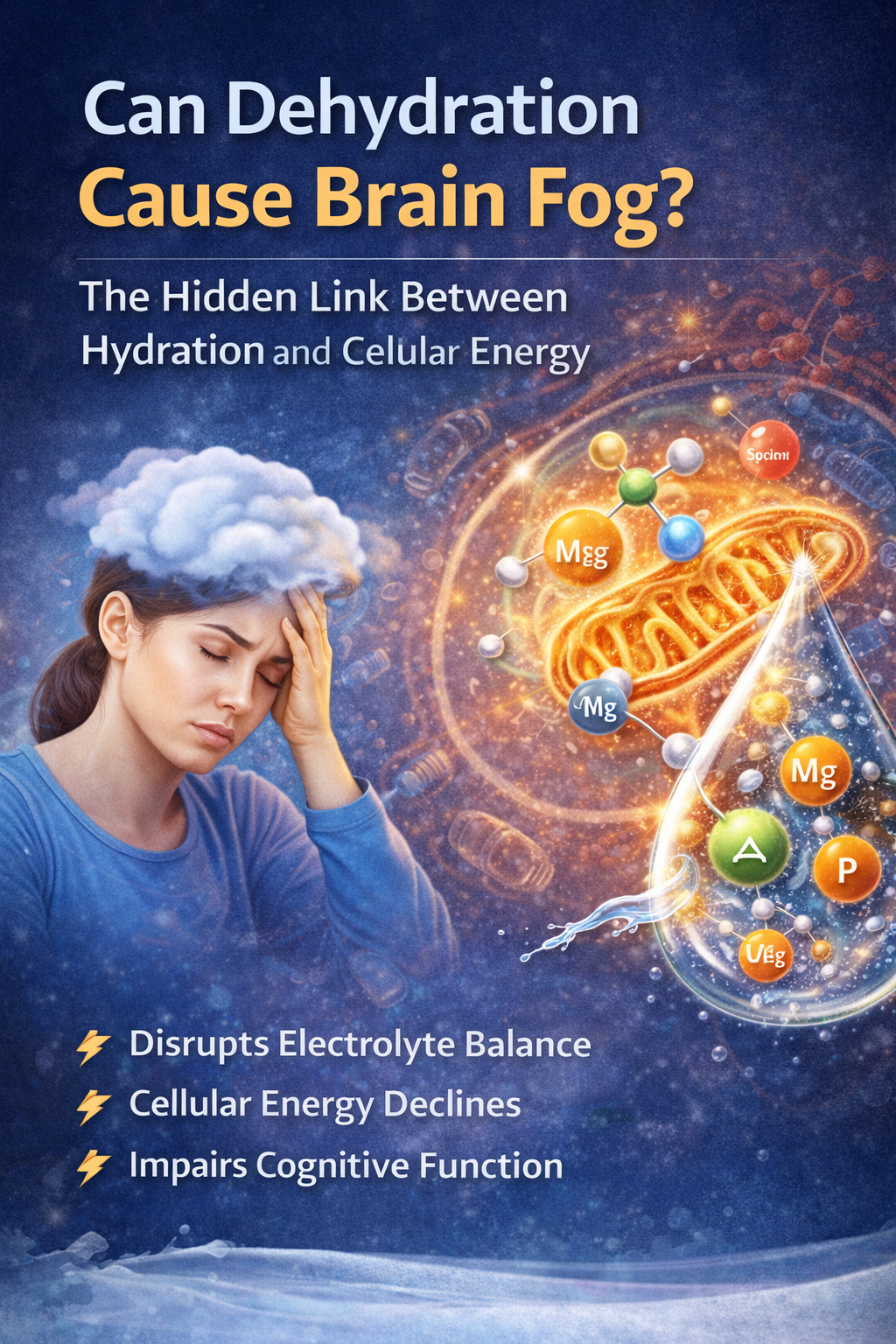
Can Dehydration Cause Brain Fog? The Hidden Link Between Hydration and Cellular Energy
Here’s something many people aren’t told:
In certain situations, drinking large amounts of plain water without replenishing electrolytes may worsen symptoms of brain fog.
Not because water is harmful — but because excessive plain water intake without adequate mineral replacement can dilute sodium and other electrolytes that support brain function.
This is one reason someone can feel “hydrated” and still feel foggy, slow, or mentally drained.
Dehydration can contribute to brain fog by disrupting electrolyte balance, cellular voltage, and mitochondrial ATP production. Even mild dehydration may impair cognitive performance, focus, and mental clarity — sometimes without obvious abnormalities on routine lab testing.
What Is Dehydration in Simple Terms?
Dehydration occurs when fluid and electrolyte losses exceed intake, reducing the body’s ability to maintain cellular balance, blood flow, and energy production.
Hydration is not just about water intake.
It requires proper levels of:
• Sodium
• Potassium
• Magnesium
• Chloride
• Fluid balance across cell membranes
When this balance is disrupted, cellular performance declines.
What Is Brain Fog?
Brain fog is not a medical diagnosis.
It describes symptoms such as:
• Mental fatigue
• Difficulty concentrating
• Slower thinking
• Memory lapses
• Reduced clarity
While many factors contribute to brain fog, mitochondrial energy production plays a central role.
To understand how energy is created at the cellular level, read:
What Is ATP and Why It Matters for Energy, Fatigue, and Mitochondrial Health
https://cellushine.net/blogs/news/what-is-atp-and-why-it-matters-for-energy-fatigue-and-mitochondrial-health
Hydration directly influences mitochondrial efficiency.
How Hydration Affects the Brain
The brain is approximately 75% water.
Neurons communicate through electrical signaling, which depends on:
• Sodium gradients
• Potassium gradients
• Magnesium-dependent ATP activation
• Adequate blood flow
Electrolytes maintain membrane potentials required for nerve impulse transmission.
If electrolyte balance shifts, signaling efficiency declines.
This may present as brain fog.
For a deeper look at magnesium’s role in ATP activation:
Magnesium and ATP: Why It Matters for Energy and Fatigue
https://cellushine.net/blogs/news/magnesium-and-atp-why-it-matters-for-energy-and-fatigue
Hydration and Mitochondrial ATP Production
ATP production depends on a proton gradient across the mitochondrial membrane.
Electrolytes influence:
• Membrane potential
• Enzyme activation
• Cellular voltage
• Oxygen delivery
When hydration and mineral balance decline, mitochondrial efficiency may decrease.
To explore how mitochondrial inefficiency affects energy:
Mitochondrial Dysfunction
https://cellushine.net/pages/mitochondrial-dysfunction
Research Insight: Dehydration and Cognitive Function
Research demonstrates that even mild dehydration (1–2% body weight loss) can impair:
• Attention
• Working memory
• Mood stability
• Executive function
Selected studies:
Ganio MS et al. Mild Dehydration Impairs Cognitive Performance and Mood in Young Women. Journal of Nutrition. 2011.
Armstrong LE et al. Mild Dehydration Affects Mood in Healthy Young Women. Journal of Nutrition. 2012.
Adan A. Cognitive Performance and Dehydration. Journal of the American College of Nutrition. 2012.
These findings suggest hydration status significantly influences mental clarity.
Signs Dehydration May Be Affecting You
• Headaches
• Fatigue
• Brain fog
• Muscle cramps
• Dizziness
• Dark urine
• Afternoon crashes
Many individuals increase plain water intake without replenishing electrolytes.
In certain situations, this may dilute sodium levels and worsen symptoms.
To understand hydration in greater depth:
Hydration & Electrolytes
https://cellushine.net/pages/hydration-electrolytes
Can You Be Dehydrated With Normal Labs?
Yes.
Routine electrolyte panels often remain within reference ranges unless imbalance is severe.
Mild dehydration may not trigger abnormal lab flags but can still affect:
• Cognitive clarity
• Energy levels
• Exercise tolerance
• Recovery
If you’ve been told your labs are normal but still feel foggy or drained, read:
Why Am I Tired If My Labs Are Normal?
https://cellushine.net/pages/why-am-i-tired-if-my-labs-are-normal
For deeper insight into lab pattern interpretation:
Educational Blood Lab Interpretation
https://cellushine.net/pages/educational-blood-lab-interpretation
Hydration Is More Than Water
Optimal hydration includes:
• Balanced sodium
• Adequate potassium
• Sufficient magnesium
• Trace minerals
• Proper fluid intake
Electrolyte-based hydration strategies may support cellular balance more effectively than water alone.
Hydrate™ Advanced Electrolyte Support
https://cellushine.net/products/hydrate-advanced-electrolyte-cellular-hydration-support
Hydrate™ contains:
• Magnesium bisglycinate
• Sodium bicarbonate
• Potassium bicarbonate
• Methylcobalamin (B12)
• Taurine and glycine
• Boron
These ingredients support electrolyte balance and mitochondrial function without added sugars.
Brain Fog and Iron Status
Hydration is not the only factor influencing energy and clarity.
Iron status also affects oxygen delivery and mitochondrial output.
Learn more here:
Iron, Ferritin, and Fatigue: How Low Iron Can Affect Cellular Energy
https://cellushine.net/blogs/news/iron-ferritin-and-fatigue-how-low-iron-can-affect-cellular-energy
The Bigger Picture: Brain Fog as a Cellular Signal
Brain fog is often a signal of reduced cellular efficiency.
Hydration influences:
• Circulation
• Oxygen delivery
• Electrolyte gradients
• ATP production
When hydration and mineral balance improve, mitochondrial output may improve — and mental clarity may follow.
Part of the Cellular Energy Education Series
• What Is ATP and Why It Matters for Energy, Fatigue, and Mitochondrial Health
https://cellushine.net/blogs/news/what-is-atp-and-why-it-matters-for-energy-fatigue-and-mitochondrial-health
• Magnesium and ATP: Why It Matters for Energy and Fatigue
https://cellushine.net/blogs/news/magnesium-and-atp-why-it-matters-for-energy-and-fatigue
• Iron, Ferritin, and Fatigue
https://cellushine.net/blogs/news/iron-ferritin-and-fatigue-how-low-iron-can-affect-cellular-energy
• Mitochondrial Dysfunction
https://cellushine.net/pages/mitochondrial-dysfunction
Frequently Asked Questions
Can mild dehydration cause brain fog?
Yes. Studies show even 1–2% dehydration may impair cognitive performance.
Are electrolytes important for brain function?
Yes. Sodium, potassium, and magnesium regulate nerve signaling and cellular voltage.
Is drinking more water enough?
Hydration requires fluid and electrolyte balance. Water alone may not restore optimal cellular function in some situations.
Can dehydration affect ATP production?
Yes. Electrolytes influence mitochondrial membrane gradients required for ATP synthesis.
Important Notice
This article is educational in nature and is not intended to diagnose, treat, or replace professional medical advice.