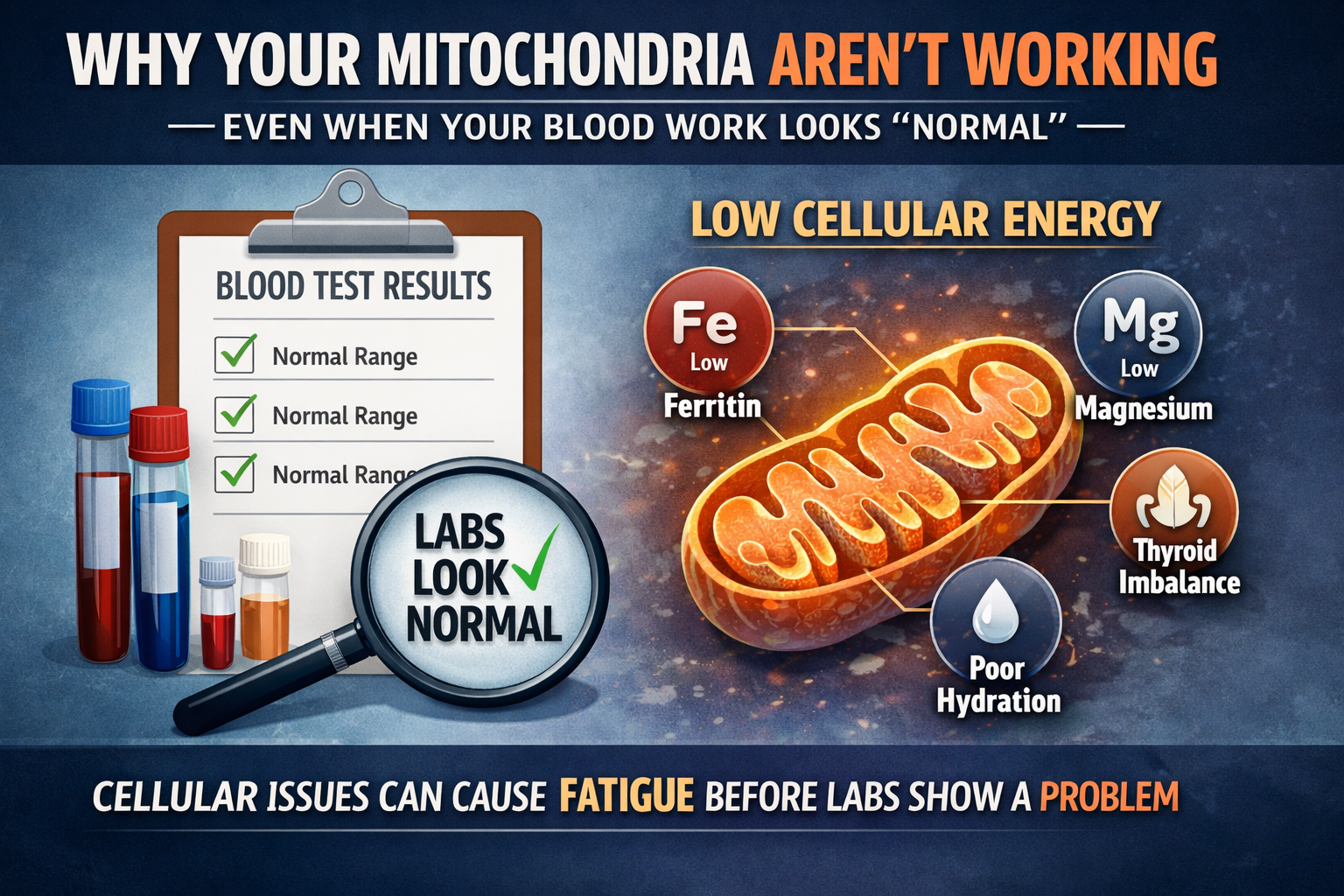
If You Feel Exhausted But Your Labs Are “Normal,” This May Be Why
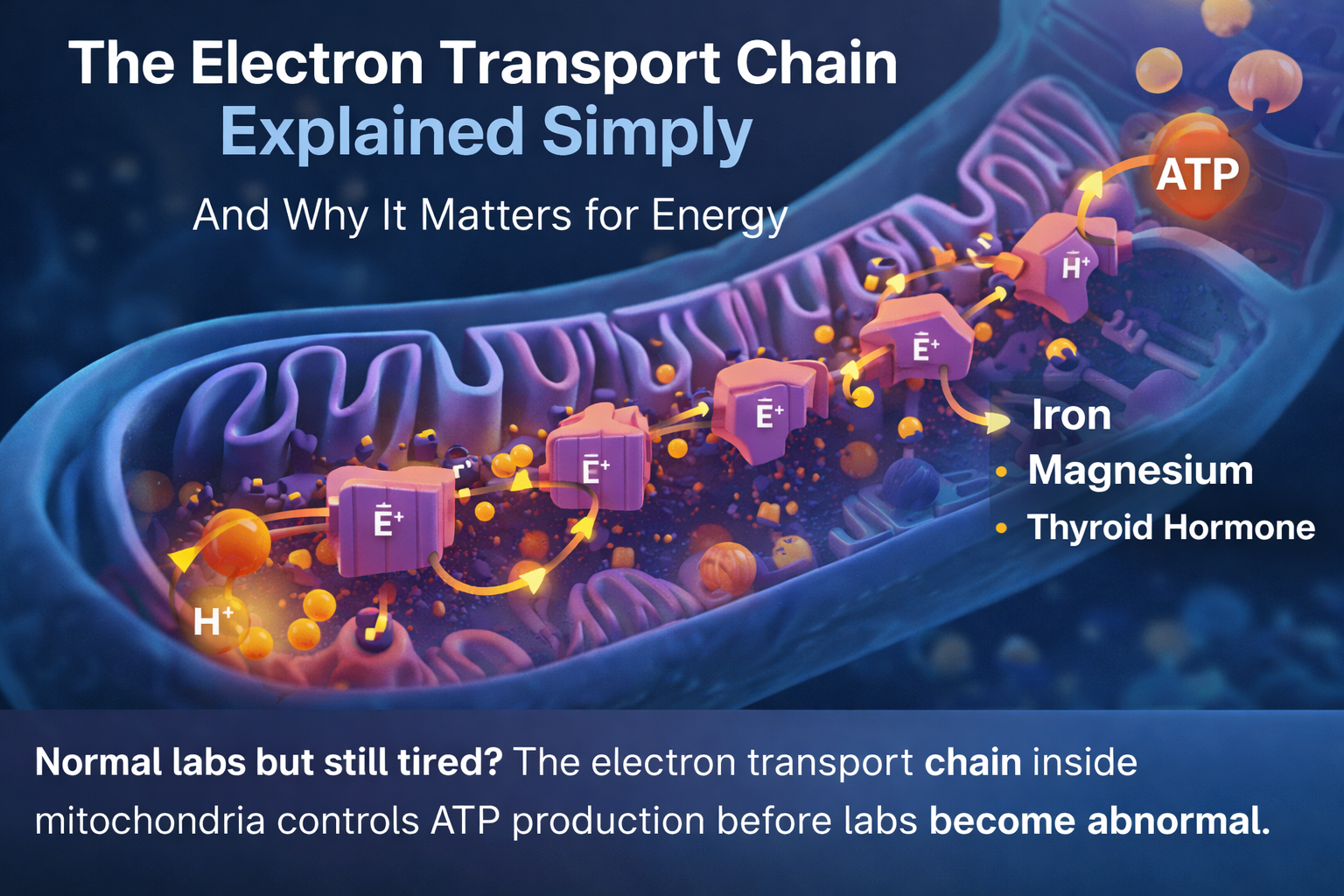
The Electron Transport Chain Explained Simply — And Why It Matters for Energy
You were told your labs are normal.
Hemoglobin? In range.
TSH? Normal.
Glucose? Fine.
So why are you exhausted?
Why do stairs feel harder than they should?
Why does your brain feel foggy by mid-afternoon?
The answer may not be in a single lab value.
It may be in something rarely discussed:
The electron transport chain.
What Is the Electron Transport Chain?
The electron transport chain (ETC) is the final stage of cellular energy production.
It occurs inside the inner membrane of your mitochondria — the energy-producing structures inside your cells.
Its purpose is simple:
To produce ATP.
ATP is the molecule your body uses for energy.
It powers:
• Muscle contraction
• Brain function
• Hormone signaling
• Temperature regulation
• Cellular repair
If ATP production slows down, fatigue appears.
Even when standard labs look normal.
How the Electron Transport Chain Works (Simplified)
Think of it like an energy conveyor system.
-
Nutrients from food are broken down.
-
Electrons are extracted and passed through protein complexes (Complex I–IV).
-
This movement pumps protons across a membrane.
-
The proton gradient powers ATP synthase.
-
ATP is created.
Oxygen is required at the final step.
But oxygen alone is not enough.
The system also depends on key nutrients and minerals.
Why Oxygen Delivery Isn’t the Whole Story
Many people equate fatigue with “low oxygen.”
That’s incomplete.
Hemoglobin measures oxygen transport in the blood.
The electron transport chain determines whether oxygen is actually used efficiently inside the cell.
This is why someone can relate to:
• Why Your Blood Work Is “Normal” — But You Still Feel Exhausted
• Low Ferritin but Normal Hemoglobin
• Thyroid and Mitochondrial Energy: Why “Normal” Labs Can Still Leave You Exhausted
Energy production is layered.
Delivery is one layer.
Utilization is another.
Iron’s Role in the Electron Transport Chain
Iron is embedded inside cytochromes and iron-sulfur clusters that drive electron transfer.¹²
Iron deficiency can impair oxidative phosphorylation before anemia develops.³
That means ferritin may decline and fatigue may appear — even while hemoglobin remains normal.
This is why iron deficiency without anemia is a real and documented pattern.
Magnesium’s Role in ATP Production
ATP must bind to magnesium to become biologically active.⁴
Low magnesium can impair ATP function, even if ATP production appears adequate.
This connects directly to:
Magnesium and ATP: Why It Matters for Energy and Fatigue
Thyroid Hormone and Mitochondrial Output
Thyroid hormones regulate mitochondrial respiration and ATP production.⁵
Normal TSH does not always equal optimal cellular energy output.
This is why thyroid discussions often overlap with mitochondrial health.
When the Electron Transport Chain Slows Down
Symptoms may include:
• Persistent fatigue
• Exercise intolerance
• Brain fog
• Cold intolerance
• Slower recovery
• Hair shedding
These patterns often intersect with:
• Low ferritin
• Suboptimal magnesium
• Dehydration
• Thyroid inefficiency
• Chronic stress load
Fatigue is rarely a single variable.
It is often a systems pattern.
Why This Matters for Lab Interpretation
Standard lab ranges are designed to detect disease.
They are not designed to optimize performance.
If someone feels exhausted while labs are “normal,” the question becomes:
Is mitochondrial efficiency optimized?
Understanding the electron transport chain reframes fatigue from a single-number issue to a cellular performance issue.
For broader context, see:
• Mitochondrial Health Essentials
• Educational Blood Lab Interpretation
Research Support
-
Rouault TA. Iron metabolism and cytochromes. Nat Rev Neurosci. 2013.
-
Lill R. Iron-sulfur cluster biogenesis. Nature. 2009.
-
Haas JD. Iron deficiency and reduced work capacity. Am J Clin Nutr. 2001.
-
Romani AM. Magnesium and ATP stabilization. Arch Biochem Biophys. 2013.
-
Mullur R. Thyroid hormone regulation of mitochondrial function. Physiol Rev. 2014.
Final Perspective
The electron transport chain is where oxygen and nutrients are converted into usable cellular energy.
If it slows, fatigue follows.
Not always disease.
Not always anemia.
Often efficiency.
Understanding this system is foundational to interpreting fatigue in the context of “normal” labs.
This article is educational in nature and not intended to diagnose or treat medical conditions.
Frequently Asked Questions
What is the electron transport chain?
The electron transport chain is the final stage of cellular respiration that occurs inside mitochondria. It produces ATP by transferring electrons through a series of protein complexes using oxygen.
Can mitochondrial dysfunction cause fatigue?
Yes. When the electron transport chain functions inefficiently, ATP production decreases. Lower ATP output may contribute to fatigue, exercise intolerance, and brain fog.
Does iron affect mitochondrial energy production?
Yes. Iron is required for cytochromes and iron-sulfur clusters within the electron transport chain. Low iron stores can impair mitochondrial efficiency before anemia develops.
Is oxygen enough to produce energy?
No. Oxygen is necessary for ATP production, but proper iron, magnesium, thyroid signaling, and nutrient availability are also required for efficient mitochondrial function.
Why can labs be normal but energy still low?
Standard laboratory ranges are designed to detect disease. Mitochondrial efficiency and nutrient optimization may decline before values fall outside standard reference ranges.