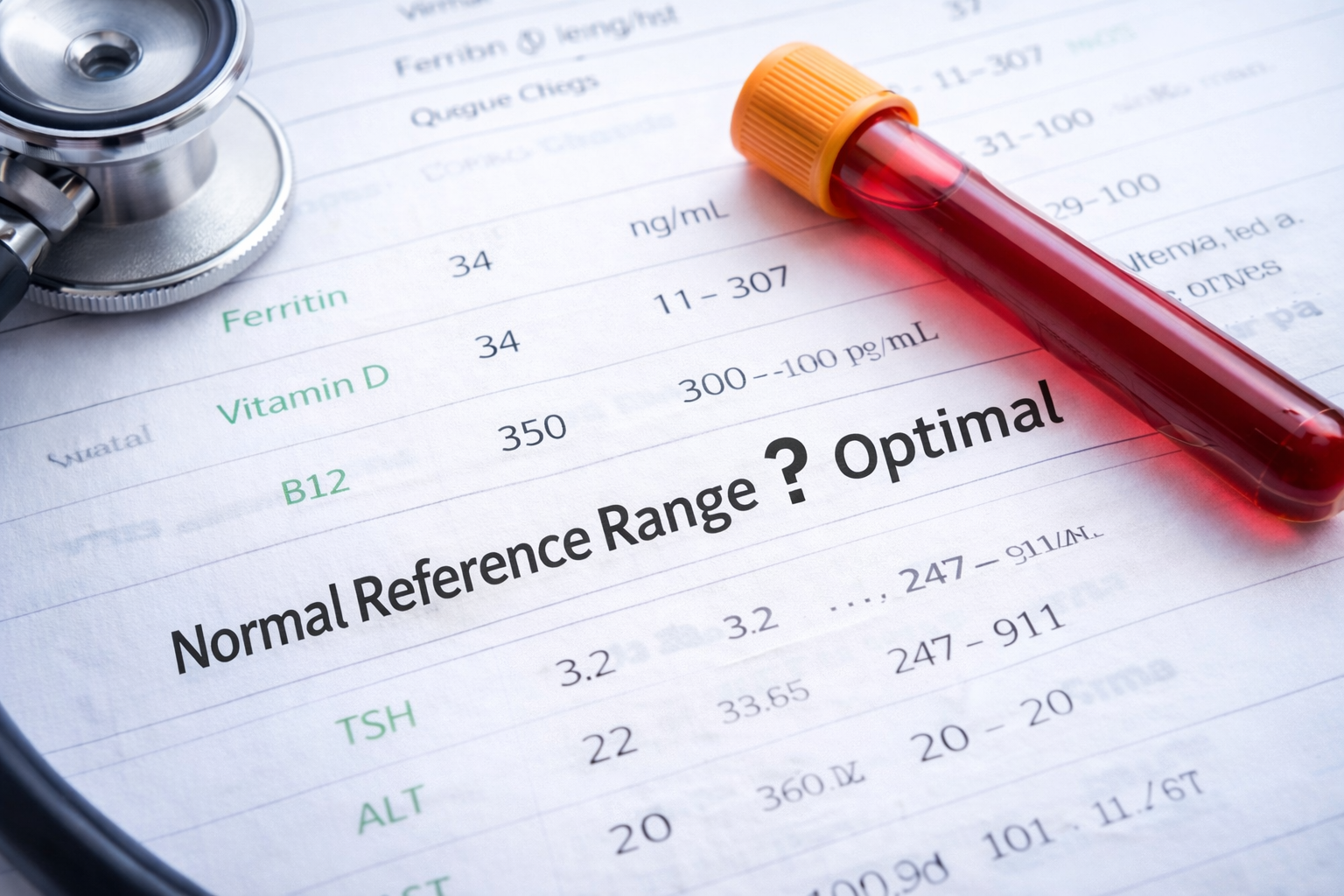
Why Your Blood Work Is “Normal” — But You Still Feel Exhausted
Most people have experienced it.
You go to your doctor. You get routine blood work. A week later you’re told:
“Everything looks normal.”
And yet…
You still feel tired.
You still struggle with brain fog.
You still wake up unrefreshed.
Your energy crashes mid-afternoon.
If your labs are normal, why don’t you feel normal?
This is one of the most searched health questions online — and the answer lies in understanding the difference between normal lab ranges and optimal cellular function.
Normal Does Not Mean Optimal
Standard blood lab reference ranges are statistical. They are not performance benchmarks.
Most lab ranges are created by collecting results from a large population and defining the middle 95% as “normal.” That means the range reflects what is statistically common — not what represents peak mitochondrial efficiency or nutrient optimization.
You can fall within that range and still:
-
Have low iron stores
-
Have sub-optimal vitamin D
-
Have borderline B12 utilization
-
Have thyroid markers trending low-normal
-
Show inflammatory markers that are technically “within range”
Individually, none of these trigger a disease flag.
Collectively, they can significantly impact how your cells produce energy.
The Question Most Medicine Doesn’t Ask
Traditional medicine asks:
Is something broken enough to diagnose?
Optimization asks:
How efficiently is this person’s cellular energy system operating right now?
Those are not the same question.
And they require different frameworks to answer.
When someone searches “why are my labs normal but I feel tired,” what they are really asking is:
Could something be functionally suboptimal even if it isn’t diagnosable?
The answer is often yes.
Fatigue Often Begins at the Cellular Level
Your mitochondria are responsible for producing ATP — the energy currency of your cells.
For mitochondria to function efficiently, they require:
-
Adequate iron availability
-
B-vitamin cofactors
-
Magnesium
-
CoQ10
-
Thyroid signaling
-
Low inflammatory burden
When multiple markers trend toward the low end of normal simultaneously, energy production may be impaired even though no single value is “abnormal.”
This is where pattern recognition becomes powerful.
Why Isolated Lab Values Can Be Misleading
A ferritin of 18 ng/mL may be labeled “normal.”
A vitamin D of 32 ng/mL may be “normal.”
A magnesium that sits near the lower threshold may be “normal.”
But when those three occur together, they form a pattern that may help explain persistent fatigue.
Blood work interpretation requires context.
It requires looking at how markers relate to one another — not just whether they cross a disease threshold.
Blood Work Interpretation: The Missing Piece
If you’ve ever felt dismissed because your labs were “fine,” what you likely needed was not another diagnosis — but better explanation.
Educational blood work interpretation looks at:
-
Optimal vs reference ranges
-
Biomarker relationships
-
Subtle shifts across systems
-
Nutrient utilization patterns
-
Early trends before disease develops
It is not medical diagnosis.
It is deeper understanding.
If you want a detailed breakdown of how this works — including how lab ranges are created and how to read common panels — read our full guide to:
👉 Educational Blood Lab Interpretation
https://cellushine.net/pages/educational-blood-lab-interpretation
That guide explains the math behind lab ranges, the difference between disease detection and optimization, and how common panels like CBC, CMP, thyroid, lipids, and iron studies fit into a cellular energy framework.
When Should You Consider a Deeper Lab Review?
You may benefit from an educational lab review if:
-
You’ve been told your labs are normal but still feel tired
-
You struggle with brain fog or slow recovery
-
You want to understand your blood work in plain language
-
You prefer an optimization-focused perspective
-
You want to ask better questions during doctor visits
Understanding your biomarkers does not replace your physician.
It helps you participate more intelligently in your care.
The Takeaway
“Normal” lab results do not guarantee optimal function.
They simply mean your numbers fall within statistical population averages.
If you feel exhausted despite normal blood work, the issue may not be a diagnosable disease — it may be a pattern of suboptimal nutrient availability or mitochondrial inefficiency.
And those patterns can often be seen long before disease thresholds are crossed.
If you're ready to understand what your blood work may really be saying, start with the full educational breakdown here:
👉 https://cellushine.net/pages/educational-blood-lab-interpretation
Educational Disclaimer
This article is for educational purposes only and does not constitute medical diagnosis, treatment advice, or a replacement for your licensed healthcare provider. Always consult your healthcare professional regarding medical concerns.