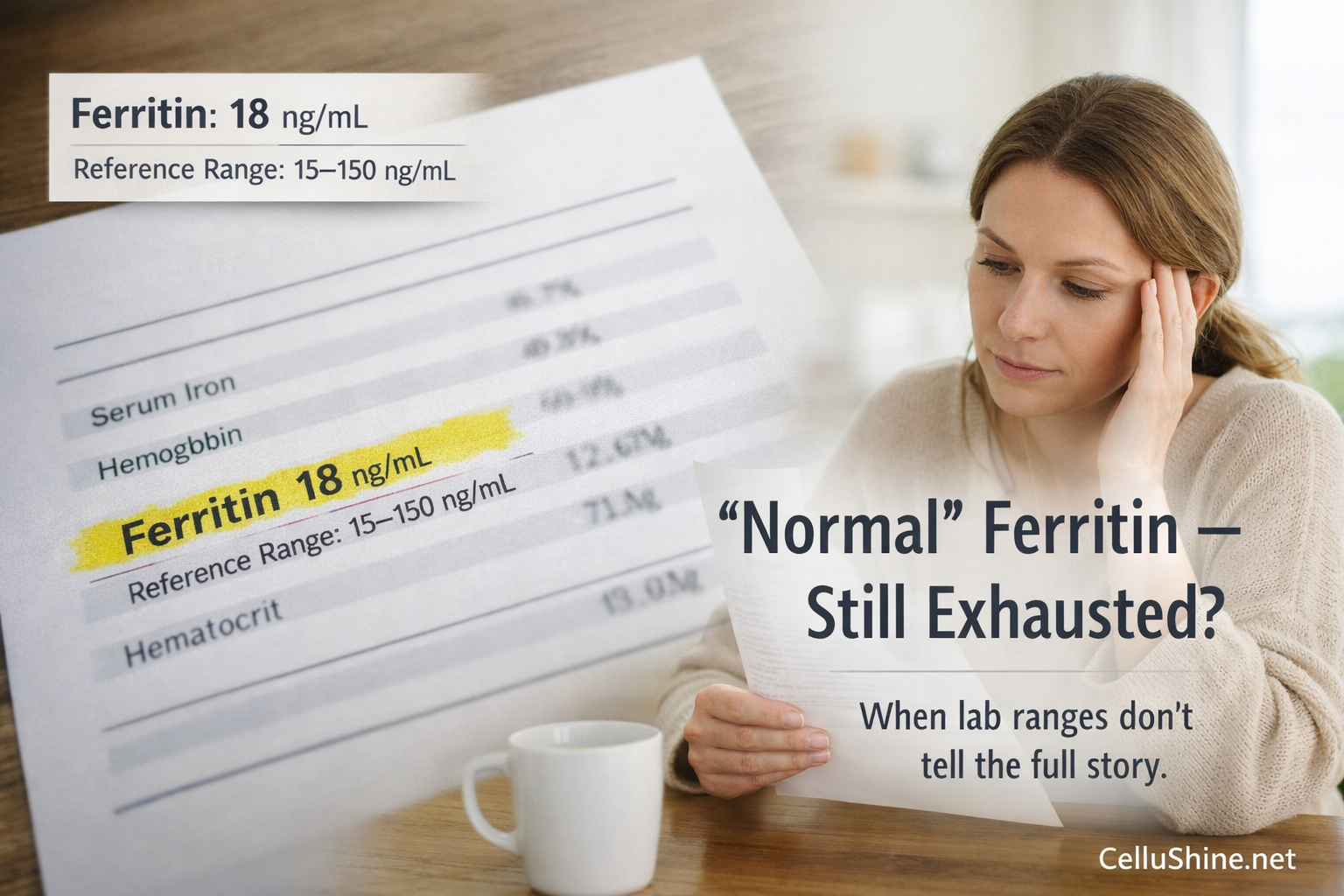
Ferritin 20 – Is That Really Normal?
If you’ve ever been told your iron labs are “normal” — but you still feel tired — you’re not alone.
One of the most common lab values behind unexplained fatigue is ferritin.
And one of the most common numbers people see is this:
Ferritin: 20 ng/mL
Technically, that may fall inside the reference range.
But is it truly optimal?
Let’s break this down.
What Is Ferritin?
Ferritin is a protein that stores iron inside your cells.
It reflects your iron reserves, not just the iron floating in your bloodstream.
This distinction matters.
Serum iron can fluctuate daily.
Ferritin shows longer-term storage.
Iron plays a critical role in:
-
Oxygen transport
-
Red blood cell production
-
Thyroid function
-
Mitochondrial energy production
-
Cognitive performance
When ferritin trends low — even if it isn’t “deficient” — energy production may suffer.
Why Ferritin 20 Is Often Called “Normal”
Most laboratory reference ranges for ferritin look something like:
15–150 ng/mL (women)
30–400 ng/mL (men)
If your ferritin is 20, the lab may flag it as normal.
But here’s the important detail:
Reference ranges are statistical.
They reflect population averages — not performance optimization.
A number can be common without being ideal.
The Problem With “Normal” Iron Stores
Ferritin of 20 often appears in people who report:
-
Persistent fatigue
-
Cold intolerance
-
Hair shedding
-
Brain fog
-
Shortness of breath during exercise
-
Poor recovery
-
Heavy menstrual cycles (in women)
Individually, these symptoms don’t trigger a disease diagnosis.
Collectively, they may suggest that iron reserves are running low.
Iron is required for hemoglobin production, which carries oxygen.
But iron is also required inside the mitochondria — where cellular energy (ATP) is produced.
When iron availability trends low, oxygen delivery and cellular energy production can both be impacted.
That doesn’t always show up as anemia.
It shows up as exhaustion.
Iron, Oxygen, and Mitochondria
Your mitochondria use oxygen to produce ATP — the energy currency of your body.
Iron is a key component of:
-
Hemoglobin (oxygen transport)
-
Myoglobin (muscle oxygen storage)
-
Cytochromes (electron transport chain function)
When ferritin stores are low-normal, mitochondrial efficiency may decline.
You may not be “anemic.”
But you may not feel vibrant either.
This is one reason many people search:
“Why am I tired if my labs are normal?”
If that’s you, we break down the full pattern explanation here:
👉 Educational Guide: Why You’re Tired Even With Normal Labs
https://cellushine.net/pages/why-am-i-tired-if-my-labs-are-normal
That guide explains how lab patterns — not isolated numbers — influence energy.
Ferritin 20 vs. Functional Ranges
Some optimization-focused practitioners look at ferritin differently.
While reference ranges may start around 15, many people report improved energy when ferritin sits higher within range.
Again — this is not about diagnosing deficiency.
It’s about understanding patterns.
Ferritin of 20 might be:
-
“Normal” statistically
-
Low relative to symptoms
-
Trending downward over time
Trend direction matters.
Context matters.
And so do companion markers.
Ferritin Should Not Be Evaluated Alone
If ferritin is 20, it helps to also look at:
-
Hemoglobin
-
Hematocrit
-
MCV
-
MCH
-
RDW
-
Serum iron
-
TIBC
-
Transferrin saturation
-
CRP (inflammation marker)
Why?
Because inflammation can elevate ferritin artificially.
Low ferritin can indicate depleted iron stores.
High ferritin can reflect inflammation.
This is why pattern recognition is essential.
One number rarely tells the whole story.
Common Causes of Low-Normal Ferritin
Ferritin of 20 is often seen in:
-
Women with heavy cycles
-
Endurance athletes
-
Frequent blood donors
-
Vegetarians / low red meat intake
-
People with digestive absorption issues
-
Individuals with chronic inflammation
-
Post-pregnancy women
It may also trend downward during prolonged stress.
Iron metabolism is influenced by inflammatory signaling and hepcidin regulation.
Again — context matters.
Symptoms Often Linked to Low Iron Stores
Even without anemia, low-normal ferritin may be associated with:
-
Brain fog
-
Low motivation
-
Exercise intolerance
-
Cold hands and feet
-
Brittle nails
-
Restless legs at night
-
Pale skin
-
Slow recovery from illness
If multiple of these are present, looking deeper may be helpful.
Why Doctors Don’t Flag It
Traditional medicine focuses on diagnosing disease.
Anemia requires specific criteria:
-
Low hemoglobin
-
Low hematocrit
-
Abnormal red cell indices
If those aren’t present, iron deficiency is not diagnosed.
That does not mean iron stores are optimal.
It means they don’t meet disease thresholds.
There’s a difference between:
-
Disease detection
-
Functional optimization
Should You Supplement Iron Automatically?
No.
Iron supplementation should never be automatic.
Iron is powerful.
Too much iron can be harmful.
Iron overload is dangerous.
That’s why context matters.
Low ferritin must be interpreted alongside:
-
Inflammatory markers
-
Full iron panel
-
Symptoms
-
Trend over time
-
Overall lab pattern
This article is educational only.
It is not medical advice.
Always consult your healthcare provider before making changes.
The Bigger Picture: Fatigue Is Usually Multi-Factorial
Ferritin of 20 might be part of the story.
But fatigue often reflects multiple contributors:
-
Low iron stores
-
Vitamin D trending low
-
Magnesium at the bottom of range
-
B12 suboptimal utilization
-
Thyroid trending low-normal
-
Blood sugar variability
-
Chronic stress load
This is why isolated lab values can mislead.
Patterns reveal more.
If you want to understand how these patterns connect — especially when labs are technically normal — start here:
👉 Why Am I Tired If My Labs Are Normal?
https://cellushine.net/pages/why-am-i-tired-if-my-labs-are-normal
When to Consider a Deeper Educational Review
You may benefit from reviewing your iron labs more thoroughly if:
-
You’ve been told your labs are normal but still feel fatigued
-
Ferritin sits below 30
-
You have multiple low-normal markers
-
You experience persistent brain fog
-
You feel cold or sluggish despite normal thyroid tests
-
You want to understand your labs before your next doctor visit
Understanding your biomarkers helps you ask better questions.
It does not replace your physician.
The Takeaway
Ferritin of 20 may fall within the laboratory reference range.
But “normal” does not automatically mean optimal.
Iron plays a foundational role in oxygen delivery and mitochondrial energy production.
When ferritin trends toward the low end of normal — especially alongside fatigue — a deeper look at lab patterns may be warranted.
If you feel exhausted despite normal blood work, you’re not imagining it.
The answer may lie in patterns — not disease thresholds.
To explore that framework in detail, read:
👉 Educational Guide: Why You’re Tired Even With Normal Labs
https://cellushine.net/pages/why-am-i-tired-if-my-labs-are-normal
Educational Disclaimer
This article is for educational purposes only and does not constitute medical diagnosis, treatment advice, or a replacement for your licensed healthcare provider. Always consult your healthcare professional regarding medical concerns.