CoQ10 Deficiency in Lee’s Summit: How Low Cellular Energy Can Contribute to Fatigue and Brain Fog
You're not lazy. You're not 'just getting older.' In Lee's Summit and across the eastern KC metro, thousands wake up exhausted after a full night's sleep, power through coffee, push through workouts... and still crash hard by 3 PM with brain fog so thick it feels like wading through mud. Sound familiar? The frustrating truth: Your 'normal' labs aren't telling the full story—your cells might be starving for energy at the source.
In many cases, persistent fatigue may relate to subtle metabolic changes occurring inside the mitochondria, the structures responsible for producing cellular energy.
One compound that plays a critical role in this process is Coenzyme Q10 (CoQ10).
What Is CoQ10?
Coenzyme Q10, often called CoQ10, is a vitamin-like compound found in nearly every cell of the body.
Its primary role is inside the mitochondria, where it helps generate ATP (adenosine triphosphate) — the main energy molecule used by cells.
ATP powers nearly every biological process in the human body, including:
• muscle contraction
• brain activity
• heart function
• metabolic reactions
• cellular repair
Without efficient ATP production, many people experience symptoms such as fatigue, brain fog, and reduced physical endurance.
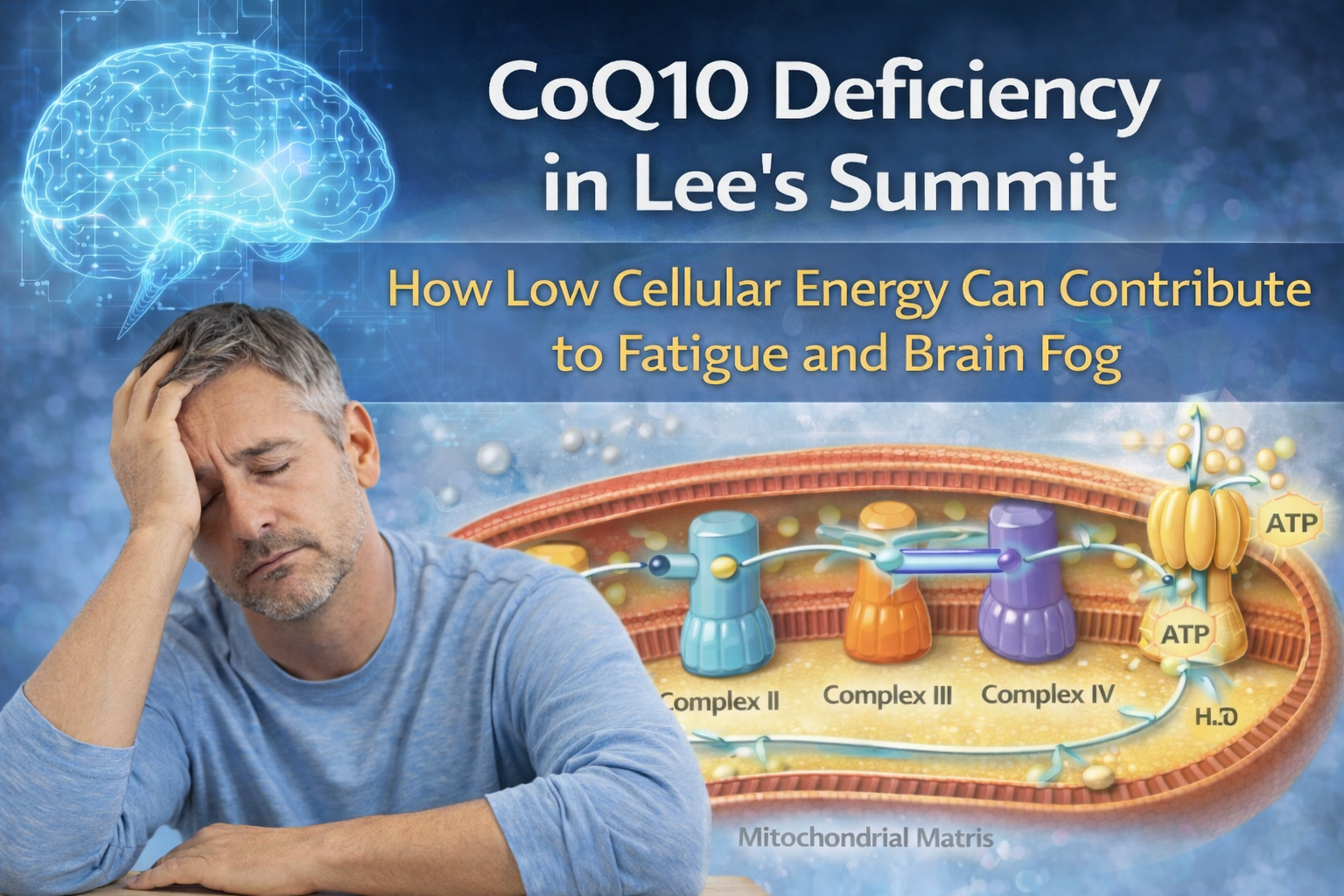
CoQ10 plays a central role in the mitochondrial electron transport chain, the system responsible for producing ATP.
You can learn more about how this system works in the:
The Mitochondrial Energy Connection
Every cell in the human body relies on mitochondria to generate energy.
Within the mitochondria, nutrients are converted into ATP through a multi-step process known as oxidative phosphorylation.
CoQ10 functions as an electron carrier in this process, transferring electrons between enzyme complexes inside the mitochondrial membrane.
This electron transfer allows cells to generate ATP efficiently.
Because of this role, CoQ10 is considered one of the most important cofactors in cellular energy metabolism.
When mitochondrial efficiency declines, symptoms such as fatigue and brain fog may appear.
This concept is explained further in:
👉 What Is Mitochondrial Dysfunction?

CoQ10 and Fatigue
Researchers have increasingly studied the relationship between CoQ10 levels and fatigue.
Multiple clinical studies have observed that lower CoQ10 levels may be associated with reduced mitochondrial energy production.
In several clinical trials, CoQ10 supplementation has been shown to improve fatigue scores and cellular energy metabolism in certain populations.
While fatigue has many possible causes, mitochondrial nutrient status — including CoQ10 availability — may influence cellular energy production.
Why CoQ10 Levels May Decline
Several factors may influence CoQ10 levels in the body.
Aging
Natural CoQ10 production gradually declines as people get older.
Statin Medications
Statins reduce cholesterol production by blocking the mevalonate pathway, which is also used to produce CoQ10.
This is why statin therapy is sometimes associated with lower CoQ10 levels.
Metabolic Stress
Chronic inflammation, oxidative stress, and high metabolic demand may increase the body's need for mitochondrial cofactors.
Nutrient Imbalances
CoQ10 synthesis relies on several nutrients involved in mitochondrial metabolism.
Because of these factors, some individuals may experience reduced cellular energy production long before laboratory markers show obvious abnormalities.
Symptoms Sometimes Associated With Low Cellular Energy
When mitochondrial metabolism slows down, people may report symptoms such as:
• persistent fatigue
• brain fog
• reduced mental clarity
• muscle weakness
• poor exercise tolerance
• slow recovery after stress
Many of these symptoms overlap with metabolic patterns discussed throughout the CelluShine fatigue series.

Related Fatigue Articles in the CelluShine Knowledge Network
Several articles on this site explore metabolic contributors to fatigue.
👉 Why “Normal” Lab Results Don’t Always Explain Your Fatigue
https://cellushine.net/blogs/news/why-normal-lab-results-dont-always-explain-your-fatigue
👉 Hydration & Electrolytes: The Missing Link in Fatigue
https://cellushine.net/blogs/news/hydration-electrolytes-the-missing-link-in-fatigue-lab-results-and-cellular-energy
👉 Low Iron Symptoms in Lee’s Summit
https://cellushine.net/blogs/news/low-iron-symptoms-in-lee-s-summit-why-you-feel-exhausted-even-with-normal-blood-tests
👉 Vitamin Deficiencies and Fatigue in Lee’s Summit
https://cellushine.net/blogs/news/why-vitamin-deficiencies-cause-fatigue-in-lee-s-summit-even-when-blood-tests-look-normal
You can also explore the broader nutrient overview here:
👉 The Vitamin & Mineral Deficiency Map
https://cellushine.net/blogs/news/the-vitamin-mineral-deficiency-map
Together these articles explain how multiple metabolic pathways influence cellular energy production.
Supporting Cellular Energy
Because mitochondrial energy production depends on many metabolic pathways, nutritional strategies sometimes focus on supporting multiple energy cofactors simultaneously.
CoQ10 is frequently discussed in mitochondrial research because of its role in:
• electron transport
• ATP generation
• antioxidant defense
• cardiovascular metabolism
If you're interested in learning more about CoQ10 within the CelluShine system:
👉 CelluShine CoQ10 – Powerful Antioxidant & Cellular Energy Support
This formulation is designed to support metabolic processes involved in cellular energy production and antioxidant protection.

Serving Lee’s Summit and the Surrounding Communities
CelluShine is based in Lee’s Summit, Missouri, and many readers exploring fatigue and cellular energy topics on this site live throughout the eastern Kansas City metro region.
Communities frequently researching fatigue and brain fog include:
Lee’s Summit • Greenwood • Raytown • Blue Springs • Independence • Grain Valley • Oak Grove • Harrisonville • Belton • Raymore • Kingsville • Holden • Kansas City • Lone Jack • Pleasant Hill • Peculiar • Grandview
Because these communities share many of the same lifestyle and environmental stress factors, patterns such as fatigue and low cellular energy are commonly reported across the region.
If you live in Lee’s Summit or nearby communities and want to better understand how metabolic patterns may appear in blood work, you can learn more here:
👉 Lee’s Summit Blood Lab Interpretation
Frequently Asked Questions
What does CoQ10 do in the body?
CoQ10 helps mitochondria produce ATP by transferring electrons within the mitochondrial respiratory chain.
Can low CoQ10 contribute to fatigue?
Research suggests that reduced CoQ10 availability may influence mitochondrial energy production, which can contribute to fatigue symptoms.
Does CoQ10 support heart health?
Because the heart requires large amounts of cellular energy, CoQ10 is often studied in relation to cardiovascular metabolism and antioxidant protection.
Scientific References
Mantle D. Mitochondrial Dysfunction and Coenzyme Q10
Tsai IC. CoQ10 Supplementation and Fatigue Meta-analysis
Sood B. Coenzyme Q10 – StatPearls
Hidalgo-Gutiérrez A. Metabolic Targets of CoQ10
Alcázar-Fabra M. Coenzyme Q in the Respiratory Chain
Internal Pillar Pages
For deeper research on fatigue and metabolic physiology:
• Cellular Energy Framework
https://cellushine.net/pages/cellular-energy-framework
• Mitochondrial Dysfunction
https://cellushine.net/pages/mitochondrial-dysfunction
• Hydration & Electrolytes
https://cellushine.net/pages/hydration-electrolytes
• Optimal vs Standard Lab Ranges
https://cellushine.net/pages/optimal-vs-standard-lab-ranges
These pages form the CelluShine Cellular Energy Knowledge Network, explaining how fatigue, metabolism, mitochondria, and nutrient physiology interact.