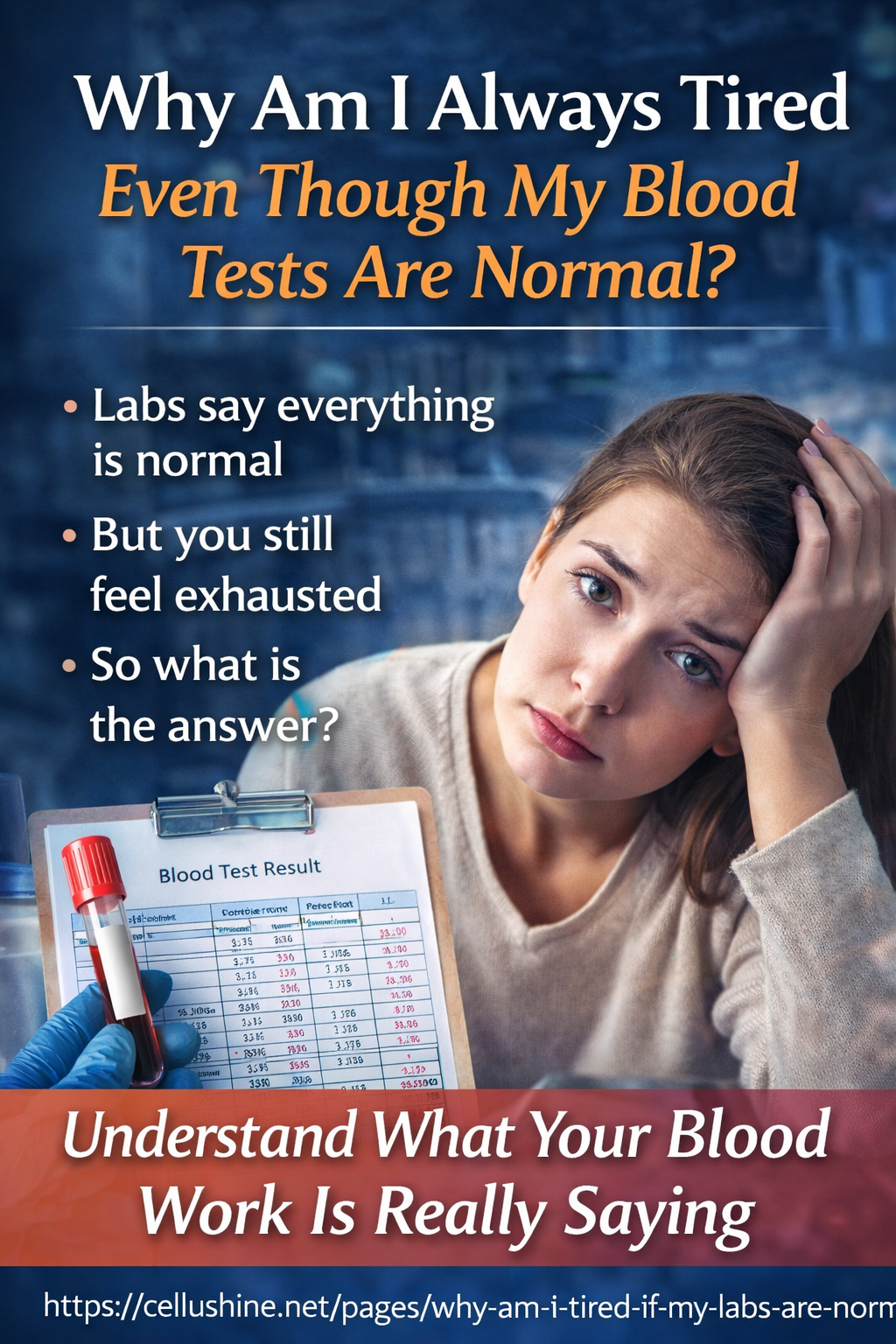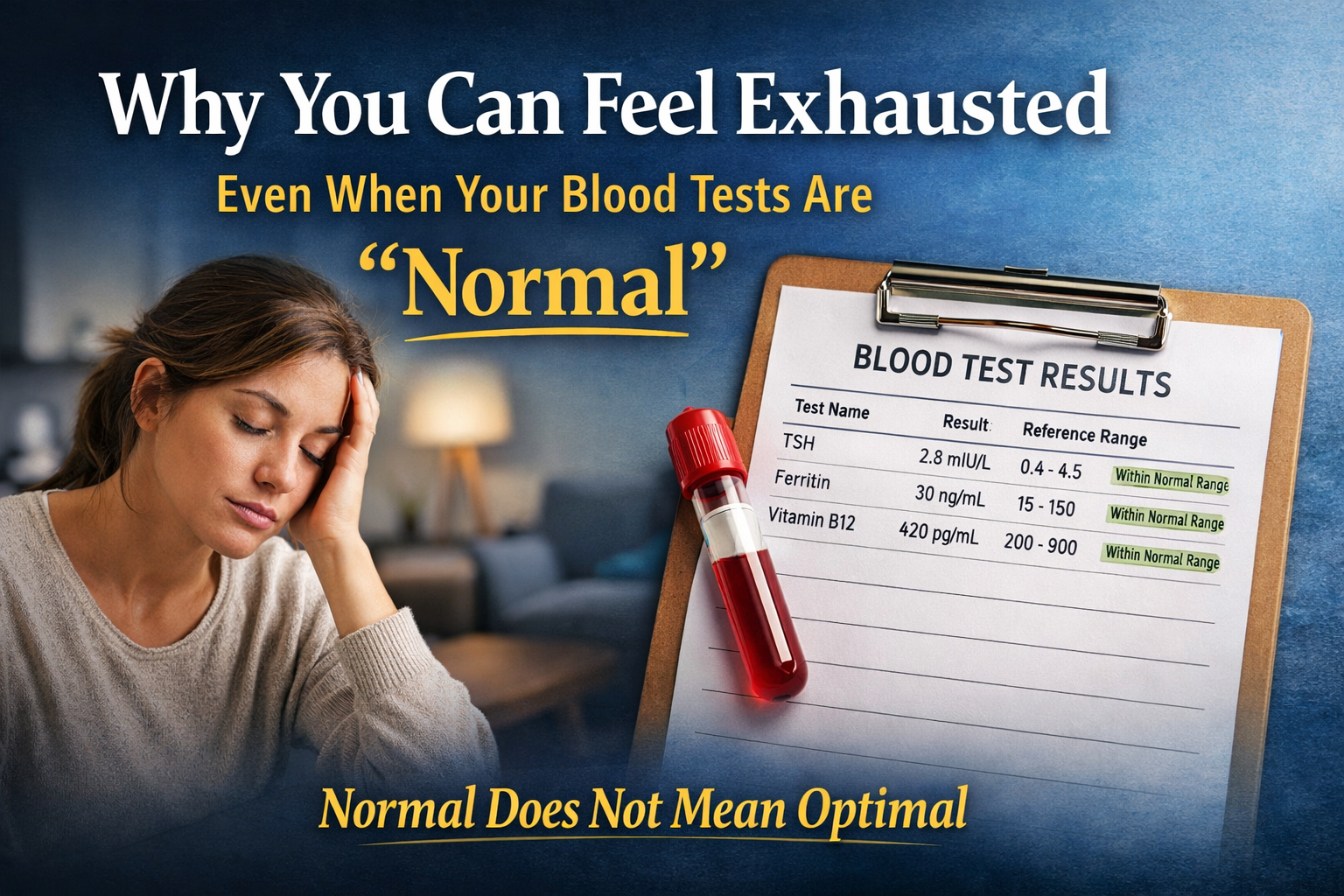
Why You Can Feel Exhausted Even When Your Blood Tests Are “Normal”
You’re doing what you’re supposed to do.
You show up for work.
You take care of your family.
You try to eat better, sleep more, and make healthier choices.
But something still doesn’t feel right.
Your energy fades halfway through the day. Your mind sometimes feels foggy. Some days your body just feels slow or drained for no obvious reason.
Eventually you decide to check your labs.
A few days later the results come back:
“Everything looks normal.”
For many people, that’s where the conversation ends — but the symptoms don’t.
The Frustration of “Normal” Lab Results
Hearing that your lab tests are normal can be confusing when you still feel exhausted.
You may begin questioning yourself.
Maybe you're just stressed.
Maybe you’re not sleeping enough.
Maybe you’re expecting too much from your body.
But there is an important concept that many people never hear:
Normal does not always mean optimal.
Most laboratory reference ranges are designed to detect disease, not to measure optimal metabolic performance.
This means your results can technically fall within the normal range while your metabolism is still under stress.
The Gap Between Normal and Optimal
Laboratory reference ranges are based on statistical averages.
In simple terms, labs determine where most of the population falls. If your numbers land within that statistical range, the result is considered normal.
However, averages do not necessarily represent optimal physiology.
Many people experience symptoms long before lab markers move outside standard ranges. Energy metabolism, nutrient utilization, and cellular processes can begin to struggle while numbers still appear technically normal.
This is why someone may experience symptoms like:
• persistent fatigue
• brain fog
• slow recovery from stress or exercise
• low motivation or mental clarity
• feeling inflamed or metabolically “off”
even though their lab report does not show anything alarming.
Your Body Runs on Cellular Energy
At the center of all of this is something simple but often overlooked:
cellular energy.
Every cell in your body relies on metabolic processes that convert nutrients into usable energy. These processes depend on multiple interconnected systems, including:
• mitochondrial energy production
• nutrient cofactors such as B vitamins and magnesium
• iron and oxygen transport
• thyroid signaling
• hydration and electrolyte balance
• inflammation and recovery pathways
When several of these systems become less efficient, fatigue is often one of the first symptoms people notice.
But those subtle shifts do not always push lab markers outside standard ranges.
Looking at Patterns Instead of Individual Numbers
Traditional lab reports often evaluate markers individually.
However, metabolic function is rarely determined by a single number. It is more often about patterns across multiple markers.
For example, several lab values that appear “low-normal” or “high-normal” may together reveal that metabolism is working harder than it should.
Pattern-based interpretation can sometimes help explain why someone feels exhausted even when individual lab markers appear acceptable.
Understanding the Story Behind Your Labs
When people begin to understand the physiology behind their lab results, something important happens.
Confusion starts to turn into clarity.
Instead of wondering why they feel the way they do, they begin to see how different systems in the body interact and influence energy, recovery, and metabolic performance.
Understanding these patterns does not replace medical care, but it can provide a clearer picture of how metabolism may be functioning.
And sometimes, that understanding is the first step toward making more informed decisions about health and lifestyle.
Normal Does Not Always Mean Optimal
One of the most important concepts in metabolic health is simple:
Normal does not always mean optimal.
Your body can be working harder than it should long before lab values move outside standard reference ranges.
Recognizing that possibility opens the door to a deeper understanding of your physiology and energy metabolism.
Frequently Asked Questions
Why can I feel tired if my blood tests are normal?
Standard blood tests are primarily designed to detect disease, not to measure optimal metabolic function. This means lab values can fall within normal reference ranges even when energy metabolism or nutrient utilization is not functioning efficiently.
What does “normal” actually mean on a lab test?
Laboratory reference ranges are typically based on statistical averages from the population. If your values fall within that range, they are considered normal.
However, those ranges are designed primarily to identify disease states, not to represent optimal metabolic performance.
Can several “normal” lab markers still indicate metabolic stress?
Sometimes multiple markers that fall within normal ranges can still form patterns suggesting metabolic stress.
Several values sitting near the edges of their ranges may together reveal that cellular energy production or nutrient utilization is under strain.
What systems influence energy metabolism?
Energy production in the body depends on several interconnected systems including:
• mitochondria
• nutrient cofactors
• oxygen transport
• hydration and electrolytes
• thyroid signaling
• inflammation regulation
When these systems become inefficient, fatigue is often one of the first symptoms people notice.
Learn More About Cellular Energy and Lab Interpretation
If you're interested in understanding how metabolism, energy production, and lab markers interact, these resources may help:
• Cellular Energy Framework
https://cellushine.net/pages/cellular-energy-framework
• Mitochondrial Dysfunction and Energy Production
https://cellushine.net/pages/mitochondrial-dysfunction
• Hydration, Electrolytes, and Cellular Energy
https://cellushine.net/pages/hydration-electrolytes
• Blood Lab Interpretation and Metabolic Patterns
https://cellushine.net/pages/blood-lab-interpretation
• Why Am I Tired If My Labs Are Normal?
https://cellushine.net/pages/why-am-i-tired-if-my-labs-are-normal
These educational pages explore how metabolic systems interact and how lab markers may relate to energy metabolism.